
Dynamic Designer Motion
CAD Embedded Motion Simulation
Virtual Testing Solves Big Problem at Small Company
|
How do you know a design works? Ward Machine Tool turned to virtual testing with SolidWorks and Dynamic Designer for the answer. |
|
A one-engineer machine shop in Fowlerville, Michigan, USA, Ward Machine Tool specializes in the design and manufacturing of standard and custom lathe chucks for the aluminum wheel market, rotary actuators, and specialty machining fixtures. Recently, a customer request required a custom design of a dual-actuated/multi-range aluminum wheel lathe chuck and a duplex rotary actuator to accommodate the design.
"We were a little hesitant as to whether or not the new design would work," says Bruce Emerson, Engineering Manager at Ward Machine Tool. But how do you validate a design that has never been built before? The Ward engineer anticipated design rework so a build and test approach was considered too expensive. |
|
Ward Machine Tool depends on CAD for accurate 3D models. So they decided to leverage their investment in their CAD software by adding virtual testing tools. They decided to extend their CAD environment by including Dynamic Designer from Mechanical Dynamics Inc. and a third-party FEA package. Using these tools, they were able to test and refine the functional performance of their custom design directly in the CAD system without the need to build a physical prototype. Virtual Testing"Probably like most small companies...the only way that we test designs is to build them" explains Bruce. However, this time, rather than building the chuck and actuator and testing it using trial and error, Ward Machine Tool extracted the same physical data right from the CAD system by using Dynamic Designer as a virtual testing tool. The Dynamic Designer model was easily constructed right from the solid model geometry. Assembly constraints were automatically mapped into Dynamic Designer as the proper motion constraints and curve-curve contacts were added to represent pin-in-slot characteristics. Finally, a rotational input motion was applied which accelerated the chuck to a final rotational speed of 3200 RPM. Simulations were then performed which allowed Ward to fully understand the motion of their design and gave them a powerful method by which they could determine whether or not the device would work. Several results were extracted from the simulations such as pin loads, resulting interferences, and actuator loads. Through these results, Ward quickly determined that not only were the loads on the pins excessive, they also determined that the force required to keep the largest wheel clamped at 3200 RPM would require an actuator that far exceeded the available envelope inside the lathe. Had they designed and built an actuator based on the envelope they had available, the clamp force supplied to the chuck would not have been sufficient. This problem posed unacceptable safety risks to the operator and could have caused costly damage to the lathe. Dynamic Designer also played a critical role in determining maximum pin stress. A plot of pin loads predicted peaks loads which were used as boundary conditions in their FEA software. The stress analysis indicated pin loads would cause large shear and bending stresses. What-If Studies "It was extremely easy to modify portions of the assembly and do fast what-if scenarios," said Bruce. Motor speed, assembly configuration, and wheel mass were all quickly modified which enabled the engineer to understand the design’s performance and fix the potential trouble spots. The Benefits |
|
"Dynamic Designer integrated with CAD helped us find out faster that our design would not work, which then, in turn, saved us time and money in building it." explained Bruce. Virtual tests of the new lathe chuck significantly reduced the need for physical testing. It is estimated that Ward would have spent somewhere near $45,000 to manufacture the new chuck and actuator. Physical testing probably would have taken ten times longer then the virtual testing performed with Dynamic Designer. In all, Ward was able to design their model, test it, and optimize it on the computer, before any metal was cut. The end result was large savings in time, effort, and cost associated with what would have been a costly effort. |
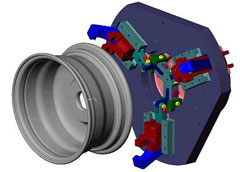 Ward
Machine Tool needed to know if a custom design of a lathe chuck
was going to work before they committed to manufacturing. The use
of virtual testing software saved them over $40,000 by helping them
to identify where the new design may fail.
Ward
Machine Tool needed to know if a custom design of a lathe chuck
was going to work before they committed to manufacturing. The use
of virtual testing software saved them over $40,000 by helping them
to identify where the new design may fail. 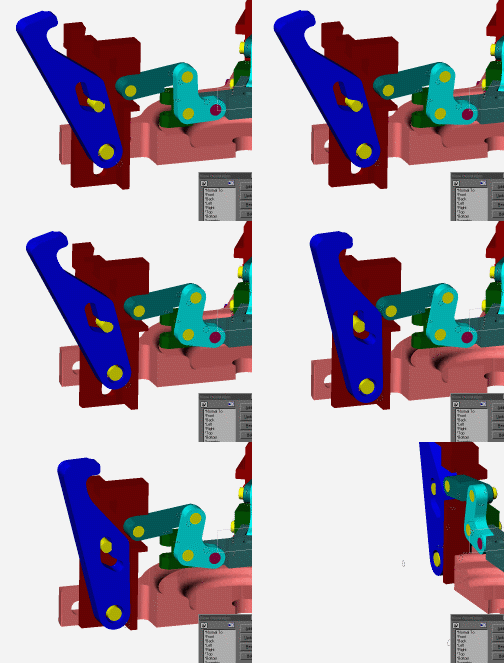 Is
the new design a valid approach? What actuators do I need? What
is the required clamping force? Will the pins sheer off? Ward Machine
Tool faced the challenge of answering these questions before they
built the chuck and actuator.
Is
the new design a valid approach? What actuators do I need? What
is the required clamping force? Will the pins sheer off? Ward Machine
Tool faced the challenge of answering these questions before they
built the chuck and actuator. 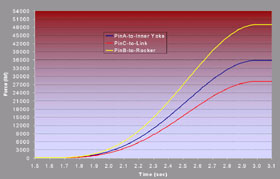 Virtual
testing not only indicated the design would not work, it facilitated
numerous what-if studies so that the critical design parameters
could be identified and alternative designs could be considered.
Virtual
testing not only indicated the design would not work, it facilitated
numerous what-if studies so that the critical design parameters
could be identified and alternative designs could be considered.
 Quote
Quote Evaluation


