
Working Model 2D
2D Dynamic Motion Simulation
NASA uses Kinematics/Dynamics Analysis as aid in Improving Passenger Survivability
Imagine dropping 9,000 pounds worth of helicopter from a height of 50 feet on purpose. That's what the NASA Impact Dynamics Research Facilityin Hampton Virginia does on a regulas basis in order to test aircraft crashworthiness. Since by definition the crash tests are destructive, they are the last tests performed on many prototype aircraft employing new construction techniques or structural materials. Other times, makes of military and comercial aircraft presently in service are tested to re-create conditions from actual crashes to learn how survivability might have been improved.
In a typical crash simulation, the subject aircraft is lifted high into the air using cables suspended from a 240-foot-high gantry once used by NASA to simulate lunar landings. Now NASA and U.S. Army engineers like Richard Boitnott duplicate real and hypothetical crash conditions by poising their subjects in a precise orientation toward the ground and then releasing them so gravity can do the rest. The aircraft are heavily instrumented so that the resulting data can be analyzed after impact.
Improving the Odds. There is one problem with this method: the testers only get one chance, so if the aircraft is dropped improperly, the data generated will likely fall outside the parameters to be measured, and the results will be compromised. To improve the odds of obtaining good data, Boitnott has begun modeling the test conditions ahead of time using Working Model, a kinematics/dynamics analysis software from Design Simulation Technologies.
Boitnott first heard about Working Model from a former professor at Virginia Tech who used Design Simulation Technologies's classroom software tool, Interactive Physics. Both programs apply the laws of physics to CAD models and measure forces such as gravity,electrostatics and air on moving bodies. The resulting data gives engineers a powerful yet easy-to-use analysis tool that helps them refine prototypes, mechanical systems and, in this case, crash tests. The test itself is like a large motion simulation, so it made sense to Boitnott to use his computer and Working Model to perform a mini run-through of the test procedures first - a test that is not destructive.
Boitnott soon acquired his own copy of Working Model. Prior to this he was using a product developed by the U.S. Army and the Federal Aviation Administration to test aircraft crashworthiness. It's user interface was not easy to use and its limited distribution kept it somewhat behind the times regarding the industry's wide use of graphical user interfaces.
"The user interface in WOrking Model is incredible,: said Boitnott. "My other program doesn't have anything like it, so immediately there's an ease-of-use factor that makes Working Model simple to learn." Working Model works in both Windows and Macintosh environments, so the familiar look of dialog boxes and pulldown menus make it simple to find what the engineer needs to build a simulation.
Before each test, Boitnott is given certain objectives, such as the angle and velocity the helicopter or aircraft is to have upon impact; for example, the helicopter must be traveling at 30 feet per second vertically and 25 feet per second horizontally and impact the ground 10 degrees nose up.
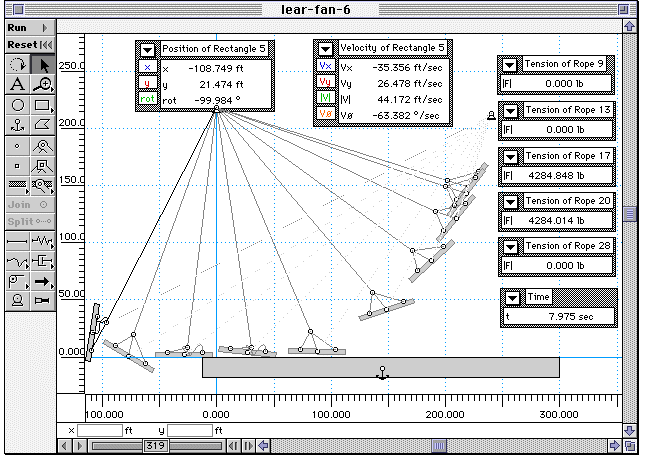 Boitnott began by modeling a helicopter using Working Model's Workspace, a sketchpad that
performs simple computer aided designs. The helicopter was represented
by a rectangular solid. He assigned mass and the moment of inertia (i.e.,
the models resistance to torque or twisting) by mouse clicking on his
helicopter body and then selecting the appropriate pulldown menu where
he could assign specific parameters using dialog boxes. Working Model
is very flexible in that it allows the user to select from many default
choices for assigning masses, or type in his own measurements. The same
is true for equations that govern the conditions of the simulation; a
user can call up defaults or type in his own values.
Boitnott began by modeling a helicopter using Working Model's Workspace, a sketchpad that
performs simple computer aided designs. The helicopter was represented
by a rectangular solid. He assigned mass and the moment of inertia (i.e.,
the models resistance to torque or twisting) by mouse clicking on his
helicopter body and then selecting the appropriate pulldown menu where
he could assign specific parameters using dialog boxes. Working Model
is very flexible in that it allows the user to select from many default
choices for assigning masses, or type in his own measurements. The same
is true for equations that govern the conditions of the simulation; a
user can call up defaults or type in his own values.
Most important to Boitnott was pinpointing the center of gravity, because this is the last point of attachment for the cables that will hoist and then remain attached during the pendulum-style fall of the helicopter to the ground. In the real test two swing cables are used to raise the aircraft, and a third pull cable is used to tilt or angle the aircraft at the correct attitude (the combination of pitch, roll and yaw) to purposely create the desired angle upon impact. The pull cable is released first, sending the aircraft angling downward, and then the two swing cables are blown off just before the moment of impact so that the helicopter is in tru freefall.
Reverse Engineering. "Then I connected the pull cable down to the center of gravity of the rectangle," said Boinott. "I actually worked backwards to see how high it had to go to land in that orientation." Boitnott, in other words, used Working Model to perform some reverse engineering - to work backwards from his known end conditions to determine how his simulation must begin to properly re-create the final seconds of his craft's fateful impact.
Once he was satisfied with the points of attachment, Boitnott positioned the model above the virtual crash site. In Working Model, Boitnott was able to run this simulation many times, adjusting the points of attachment, the approach of the helicopter before release, and the loads placed on each cable. He "dropped" his virtual helicopter over and over while Working Model timed the simulation (less that three seconds) and depicted the changes in cable loads (from static equilibrium of 2,178 pounds to 13,000 pounds dynamic load just before impact.) All Boitnott had to do was select which measurements he wanted to see during any given iteration. These graphs are selected with the mouse, and run side-byside with the simulation on screen. The entire simulation can be replayed as many times as the user wants, and the tabular results can be saved and output to hard copy for further study.
Experimenting with the helicopter's freefall angle by changing the drop conditions helped improve the odds of yielding the desired impact conditions.
"For example, I may want to know how attaching the cables to the aircraft half a foot above the center of gravity will affect the onditions of the test," said Boitnott. "Such factors are important simply because if the helicopter hits the ground at the wrong attitude, the test may be invalid."
Although safety engineers at the NASA facility have always had to perform calculations to determine tensions on the larger diameter load-bearing swing cables, there was never a method for modeling the appropriate loads on the smaller diameter pitch attitude cables that angle the aircraft in specific horizontal vs. vertical attitudes. Now there is, because Working Model monitored the tensions on all the cables as the aircraft is swinging in the air before being dropped.
"It's hard to predict the distribution of loads on three cables simultaneously. With Working Model, I can see how the tensions change from cable to cable during the trajectory downward. Knowing how those restraint cables behave will hopefully guarentee that when impact occurs the helicopter will be at the desired attitude, for example, 10 degrees nose up."
Working Model also showed the Army engineer how the crash was affected when the points of attachment were off by a few inches. "Our equations are based upon everything being perfect, but infact we don't know where the aircraft's center of gravity is." He also said cameras, anthropomorphic dummnies and other instrumentation purposefully placed on board to capture the impact data also alter the aircrafts center of gravity.
The Working Model simulation provided the answer to questions that Boitnott had not been able to ask before, such as, "How far off can I be in my attachments and still have an acceptable test?" The simulation revealed what would happen in reality if the points of attachment were too far off. "If we were off by one-half foot, we'd end up with a 15-degree nose-up crash angle when we needed 20 degrees, so that was unacceptable." To resolve this problem, Boitnott constructed a what-if scenario in Working Model, working with his simulated test conditions until the resulting impact was the proper 15 degrees. He knew the most probable way to accomplish this was either to add mass inside the vehicle or change the "hard point" attachment location. He tried changing one parameter at a time , ran the simulation to see the result, then adjusted the mass or the hard point and ran the simulation again. After several iterations, Boitnott found the correct angle was achieved by adjusting both the mass and the pull angle.
To add even more realism, Boitnott simulated the cables coming off the helicopter at a certain moment " by plugging in an equation that functioned like a countdown."
Working Model also helped Boitnott improve the safety standards of his tests. "Working Model made sure I didn't exceed the maximum acceptable cable loads while trying to acheive the right impact attitudes," added Boitnott. Boitnott was able to monitor the loads while each simulation ran by watching the meter he had chosen to measure the load fluctions.
Boitnott said his fellow engineers have been favorably impressed by these first experiments with the motion simulation software. "Working Model gives us more freedom," Boitnott said. "It speeds up our work more than any other tool I've used." Certainly the monetary savings are great when the Army or a commercial aircraft manufacturer can avoid having to repeat a crash test - and reduced the risk of injury among the crews who must mount these destructive experiments.
Boitnott has continued to look for ways to push Working Model's simulation power. He is presently writing constraint equations to model the energy absorbing response of helicopter sections that impact the ground - a measurement of the loads upon a smashing helicopter and its occupants as it reaches maximum compression.
Why drop helicopters from high places? "To understand what's going on in a crash so new aircraft can be improved structurally to protect the occupants. Most discussions in aeronautics revolve around air worthiness, not crash worthiness,: explained Boitnott, "but it needs to be addressed. We've got to increase the chances of people's survivability."
 Quote
Quote Evaluation


